Master fact families to boost mental maths speed, understand inverse operations, and build strong number sense.

Key takeaways
Table of contents
In their early maths learning, kids are introduced to number bonds, which progress to simple equations such as 4 + 1 = 5, which we sometimes refer to as number facts. Memorising number facts can be helpful for learners initially, but understanding the relationships and what is actually going on between the numbers is far more powerful when it comes to building maths ability.
This is where fact families come in!
In this guide, we’ll explain exactly what fact family maths is and why they’re important, show some examples of what they look like, and share tips for teaching it!
Put plainly, a fact family is a group of related maths sentences (or equations) that use the same sets of numbers. We use these fact families to show learners how numbers are connected across the four different operations (+, –, x and ).
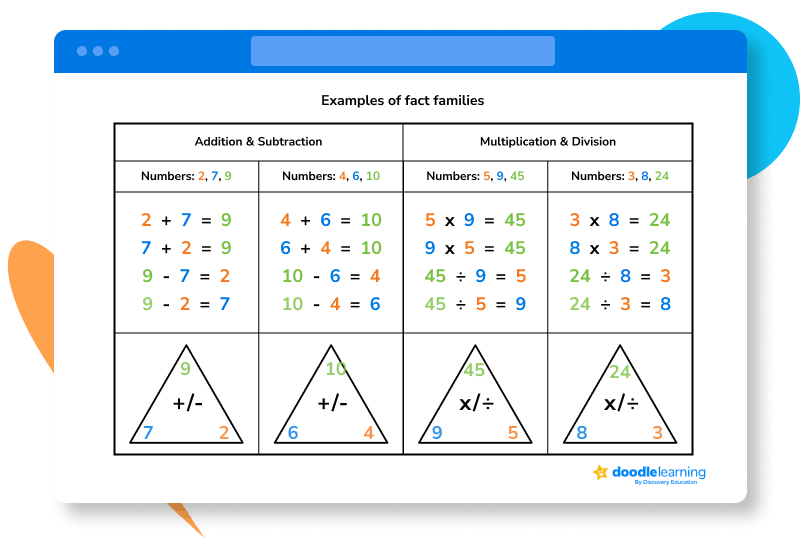
In each fact family, we see how three numbers can be used to create four related equations. When we look at fact families across the four operations, it’s useful to group them into two groups: ‘addition and subtraction’ and ‘multiplication and division’.
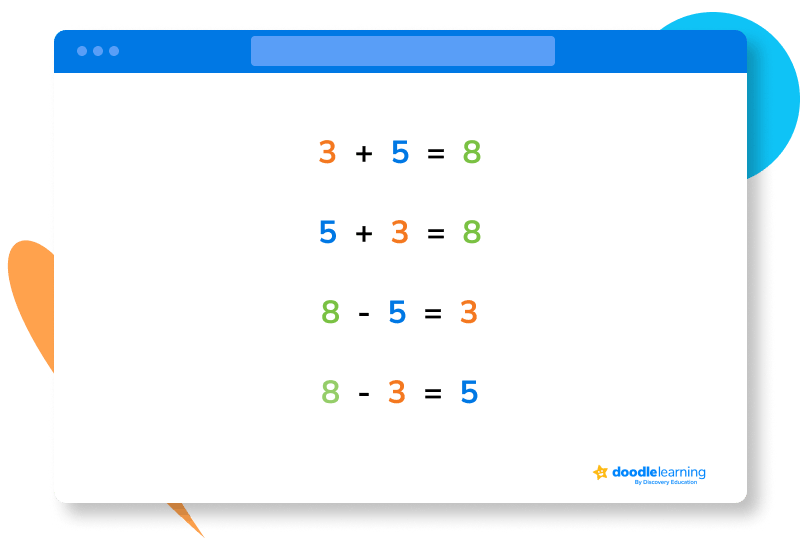
First, let’s take a look at some addition and subtraction fact families. In this example, we’ll use the numbers 3, 5 and 8 to form the following fact family:
These equations are all connected as they share the same three numbers. By learning them all together, kids can see that subtraction is the inverse (or opposite) of addition.
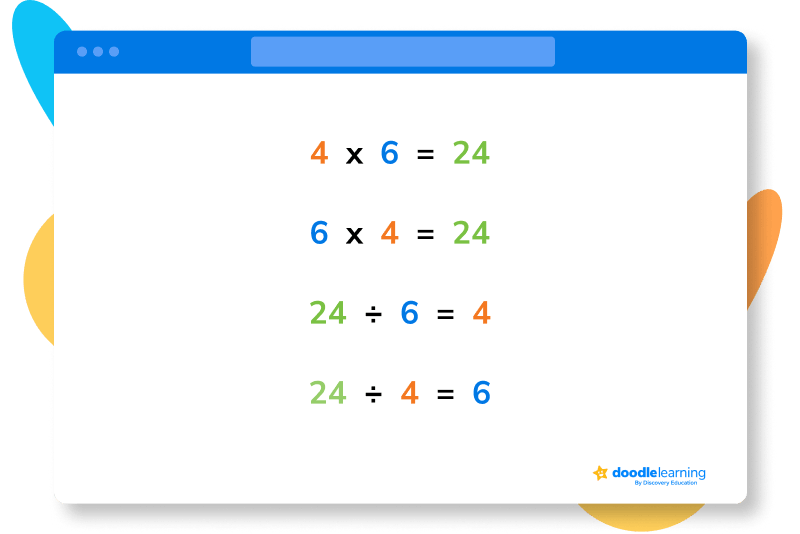
Now let’s explore a fact family that uses multiplication and division. We’ll use the numbers 4, 6, and 24 to form the following fact family:
These equations all still use the same three numbers, with only the position and symbols changing. Again, this fact family shows students an example of an inverse operation where division reverses multiplication.
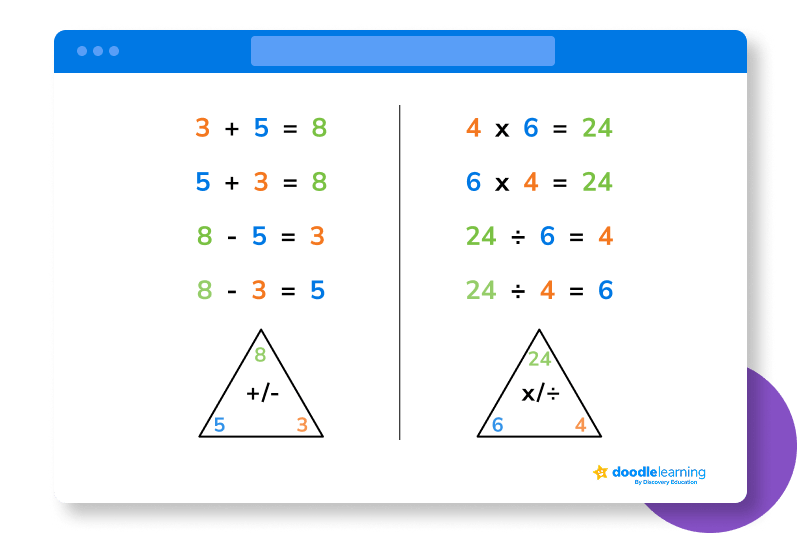
Fact family triangles are a popular visual model that I love to use in the classroom when I’m exploring this maths concept with my students. The representation drives home that each of the three numbers is “connected” through the fact family.
When creating a fact family triangle, it’s important to remember that the largest number should sit at the top of the triangle, and the two smaller numbers at the base.
Let’s turn the previous examples we used above into fact family triangles:
Depending on the type of learners you’re working with, often the visual lets them quickly visualise the relationship between the numbers and reinforces the concept of inverse operation.
Unlock unlimited maths questions
Put your learning into practice with fun exercises + games that are proven to boost ability!
Get 2 FREE weeks of Doodle!
Use code 2WKS_2026 to enjoy unlimited questions and games
Get 1 FREE month of Doodle!
Use code MONTH_2026 to enjoy unlimited questions and games
Fact family maths is a really important piece of the puzzle when it comes to early maths learning for a few different reasons. Let’s explore why:
Fact families help learners build their number sense by showing them that numbers can interact in lots of different ways.
When it comes to fact families, number sense means realising that 8 – 5 = 3 is the opposite calculation to 3 + 5 = 8. The subtraction is breaking 8 down into parts, and the addition is piecing those parts together again.
When fact families click with kiddos, you’ll know from the speed of their mental maths alone! I like to think of it as understanding fact families gives learners a shortcut to take with their mental maths.
For example, if a child knows 5 + 7 = 12, then they can easily (and quickly!) conclude that 12 – 7 =5, making a whole host of calculations faster and more efficient for them!
Simply put, inverse operations are operations that undo each other, or we sometimes say it’s the opposite operation. This idea of balance in maths is a really important concept that becomes even more important in later maths learning.
In short, fact families help children move beyond just memorising numbers and sequences, and help them understand the actual function the maths is performing. This deepens their understanding and helps to avoid any misconceptions creeping in, which can be more difficult to address in later years.
Try DoodleMaths for free!
Select a year group
Fact families are such an important concept in early maths learning, so it’s important to get this topic right when teaching it to learners. Here are a few methods I have found success with over the years when I’ve taught fact families to my learners:
Before introducing fact families, it’s important that learners have an understanding of number bonds. These show how two smaller numbers combine to make a larger number, which is the core idea behind fact families!
If students know from learning number bonds that 4 and 6 make 10, they can quickly use this knowledge to build the whole fact family!
Encourage your students to look closely at what stays the same and what changes throughout the fact family. This will help them to think more critically and will support their learning about why these families interact the way they do.
You can point out things like:
Once your learners have got the basics of fact families down, you can introduce missing number problems to test their understanding.
Examples could include:
or
These types of problems will encourage your learners to think about the relationships between the numbers rather than just recalling a rote-learned fact.
Ask your students questions that encourage them to explain why equations belong in the same family, like:
Explaining their thinking helps you as the educator to identify any misconceptions early and help your student course-correct. In addition to this, you’re also encouraging your learners to think critically and make connections that’ll deepen their overall mathematical understanding.
Fact family maths practice doesn’t need to be on a worksheet – in fact, using games can really help with learners’ motivation and confidence. DoodeLearn’s maths app lets kids work through short, interactive challenges that will help them spot the patterns and connections between numbers.
The results of over 60,000 children outlined that just 10 minutes of Doodle a day accelerates maths progress made by 79%!
Want to do more math puzzles? DoodleMaths is an award-winning maths app full of maths puzzles that are proven to double a child’s rate of progression with just 10 minutes of use a day!*
Filled with fun, interactive questions aligned to state standards, Doodle creates a unique work program tailored to each child’s needs, boosting their confidence and skills in math.
*Based on earning 24 stars a day in DoodleMaths. Read full study
Parents, sign up for a DoodleMaths subscription and see your child become a maths wizard!
Lesson credits

Mhairi Sim
Mhairi is an experienced teacher, freelance writer and parent. After completing her bachelor's degree in Psychology, she graduated as a teacher from the University of Strathclyde. She then built experience teaching across KS1 and KS2 throughout the UK. In addition to working in mainstream education, Mhairi specialised in the additional support needs sector, including social, emotional, and behavioural support.


Mhairi
Mhairi is an experienced teacher, freelance writer and parent. After completing her bachelor's degree in Psychology, she graduated as a teacher from the University of Strathclyde. She then built experience teaching across KS1 and KS2 throughout the UK. In addition to working in mainstream education, Mhairi specialised in the additional support needs sector, including social, emotional, and behavioural support.

Book a chat with our team
If you’d like to use Doodle’s browser version, please visit this page on a desktop.
To log in to Doodle on this device, you can do so through our apps. You can find out how to download them here: