








Year 1 Addition and Subtraction Guide

Boost Year 1 maths skills with our ultimate guide to addition and subtraction. Includes teaching advice, interactive activity ideas, and practice word problems for kids.

Mhairi author

Author
Mhairi Sim

Published
February 2026

Year 1 Addition and Subtraction Guide

Boost Year 1 maths skills with our ultimate guide to addition and subtraction. Includes teaching advice, interactive activity ideas, and practice word problems for kids.

Mhairi author

Author
Mhairi Sim

Published
February 2026

Year 1 Addition and Subtraction Guide

Boost Year 1 maths skills with our ultimate guide to addition and subtraction. Includes teaching advice, interactive activity ideas, and practice word problems for kids.

Mhairi author

Author
Mhairi Sim

Published
February 2026

Key Takeaways

  • By the end of Year 1, pupils should be confident with simple Year 1 addition and subtraction facts and number bonds within 10 and 20.
  • The most engaging addition and subtraction practice for Year 1 students uses concrete objects and pictorial representations. 
  • By regularly practising with hands-on addition and subtraction activities at home, we can reinforce key concepts and build fluency for our little ones.

Year 1 addition and subtraction learning forms the foundation for all later maths learning. At this stage, kiddos aren’t just learning to “do sums”, they’re learning how numbers work at the most basic level!  

The Year 1 maths National Curriculum states that Year 1 addition and subtraction should teach learners to: 

  • Read and write maths questions involving addition (+), subtraction (-), and equals (=) signs
  • Represent and use number bonds (and related subtraction facts)  to 20
  • Add and subtract numbers to 20
  • Use a mixture of concrete objects and visuals to solve one-step addition and subtraction problems

Before launching straight into activities and practice problems, it’s important to understand the core concepts of  Year 1 subtraction and addition teaching and learning, and why these are so important for future maths success. This guide explores Year 1 addition and subtraction teaching, breaking it down into simple steps and sharing fun, engaging activities to try out with your learners!

Understanding Addition and Subtraction: Key Concepts for Year 1

The key concepts for teaching Year 1 subtraction and addition fall into three main areas: composing and partitioning numbers, number bonds and facts, and signs and symbols. Let’s take a closer look at what teaching and learning should look like in each of these. 

Composing and partitioning numbers

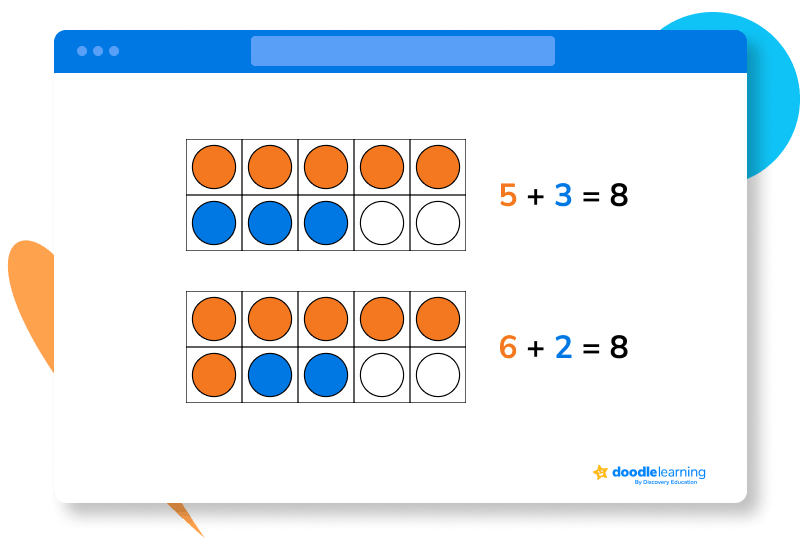
Before kiddos can even begin to add or subtract confidently, it’s important that they can see numbers as being made up of parts and wholes. For example, recognising that 8 can be 5 + 3, or 6 + 2, helps learners see how these numbers relate to each other in addition and subtraction.

year 1 addition example

A strong foundation here looks like your learner being able to: 

  • Identify different ways to add amounts together to  make the same number (like we did above with 8)
  • View subtraction as splitting a whole into two parts

Number bonds and facts

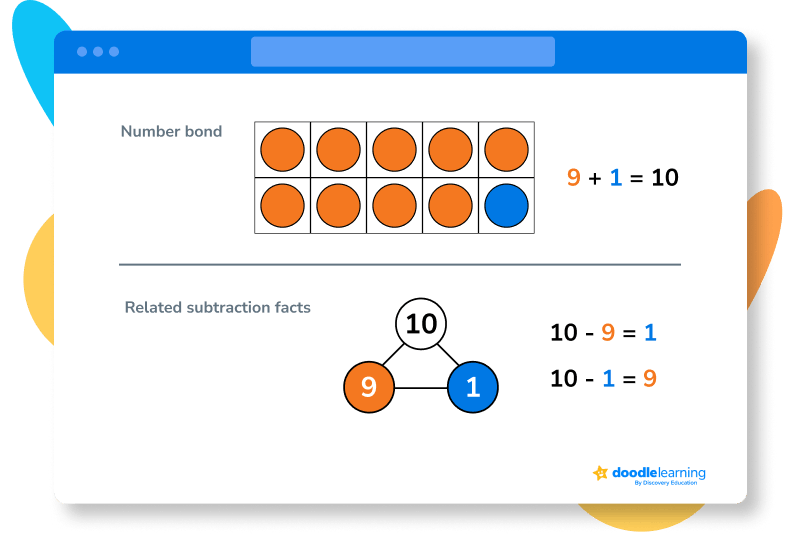
Number bonds are the next piece in the place value puzzle and are simply pairs of numbers that make a given total. Our Year 1 addition and subtraction learners should know their number bonds to 10, and they’ll be building towards knowing these up to 20.

Related to these number bonds are the Year 1 subtraction facts. These are linked in that they work backwards to partition the target number into smaller numbers. For example, these are some number bonds to 10  and the related subtraction facts:

year 1 addition and subtraction

Signs and symbols

Finally, our Year 1 addition and subtraction learners need to know the meaning and correct use of three key symbols: add (+), subtract (-), and equals (=). 

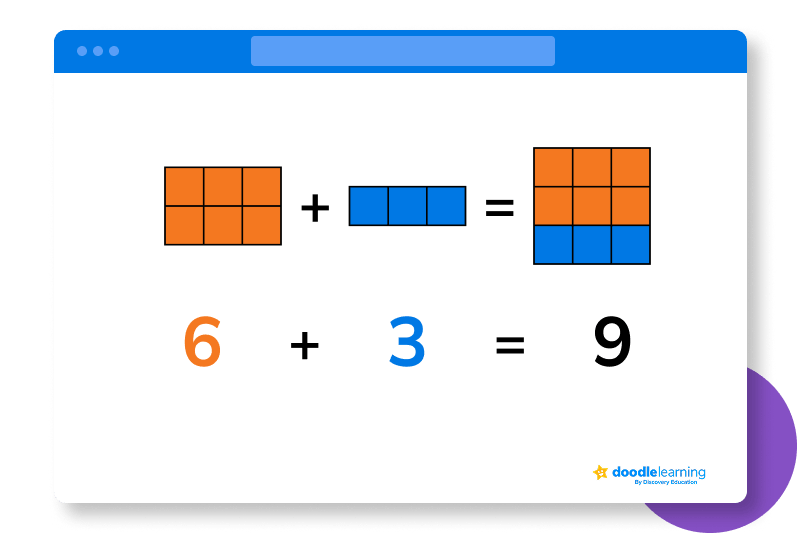
Whilst the + and – symbols speak for themselves, our little ones must understand that the equals sign is more than “here’s the answer”. It means that each side of the equation shows the same amount, or is equal. For example, in 3 + 4 = 7, both sides show the same total (7); one side shows the total partitioned into two smaller numbers. 

To illustrate this concept to learners, we often use concrete materials such as cubes or counters, as in the example below:

year 1 addition

Unlock unlimited maths questions

Put your skills to the test with fun exercises + maths games that are proven to boost ability!

Try DoodleMaths for free!

Select a year group

  • Number

  • Shape, space and measure

  • Patterns

  • Number and place value

  • Addition and subtraction

  • Multiplication and division

  • Operations (ASMD)

  • Fractions

  • Measure

  • Shape/geometry

  • Statistics

  • Ratio and proportion

  • Algebra

  • Probability

Sample questions

How to Teach Year 1 Addition and Subtraction

1. Start with concrete materials

The best place for our Year 1s to start learning to add and subtract is with concrete materials (or manipulatives, as they’re sometimes called) such as counters, cubes, buttons, beads, or toys. Using these allows them to see the actual physical meaning of the maths. 

Examples of this I’ve used in my classroom are: 

  • Give learners 5 red counters and 3 blue counters, and ask how many there are altogether
  • Start with 9 counters and remove 2, then ask how many are left

2. Use pictures and number lines

Once our learners have the physical understanding under their belts, it’s time to move on to pictorial models, such as drawings of items or even simple number lines. They could: 

  • Draw dots or colour shapes or small images to help visualise counting
  • Count forwards or back on a number line

I find that activities like these help get learning onto the page and begin to move students’ understanding from the concrete to a more abstract understanding.

3. Introduce symbols with context

The next step for Year 1 in their addition and subtraction learning is to link their understanding of manipulatives and pictures to writing maths expressions with symbols. To do this, we introduce +, –, and = slowly, ensuring that our learners understand each symbol’s meaning and purpose.

Giving them a story to follow as they use the symbols is often really helpful here! I love using these books to help illustrate the concepts to my learners:

4. Use mathematical language

Be sure to model the use of precise mathematical language with your learners to ensure that concepts are clear to them, for example: 

  • “Total” for the result of the addition
  • “Difference” for the result of subtraction
  • “How many more?” when comparing amounts

Building a strong maths vocabulary early on gives learners the tools they need to explain their reasoning and verbalise their thinking clearly. This will help massively as they progress beyond Year 1 and move up through the school.

5. Practice, practice, practice

The final stage of Year 1 subtraction and addition learning is to allow them opportunities to practice their skills in short but frequent sessions. Repeated practice will improve their recall of those all-important number bonds and the ability to apply that learning to new problems fluently.  

Engaging Activities for Year 1 Addition and Subtraction

To encourage kids to keep practising their addition and subtraction skills, it’s essential to have a bank of fun and engaging activities to keep them interested!. Here are a few activities I’ve tried and had success with, both in the classroom and at home with my own little learners:

  • Collect and Count

Have your learners go around and collect some objects, counting them once they’re finished collecting. Then have them add or take away items and talk through what they’re doing. 

  • Maths Stories

Challenge your little ones to come up with their own fun maths stories. They could be real or made-up scenarios (e.g. “We made 8 cakes and ate 3…”), but they must work out the correct answer for the end of the story either on their own or together as a group. 

  • Number Line Jumps

Create a number line on the floor or out on the playground and let your kiddos physically hop forwards and backwards as they complete addition and subtraction problems. 

  • Dice Games

In pairs or groups, have learners roll two dice and either add or subtract the numbers (whichever is your focus). The winner is the child with the highest or lowest number. 

  • Dominoes

Similar to above, use dominoes and have your kids add or subtract the number of dots. Turn it into a game by playing in teams or pairs, with the highest/lowest number winning. 

  • Shop Role Play

Add some simple price tags to toys in your playroom or classroom and let Year 1 learners play shop! Learners pick up two toys, then add up the cost using their addition skills. They can then pay with either 10p or 20p and work out how much change they’ll get using their subtraction skills.

  • Songs and rhymes

There are plenty of addition and subtraction songs and rhymes to take your pick from to support recall and reinforce key concepts. My  own son’s favourite is Danny Go’s “Math Whiz!” Addition Song, and we frequently return to this list of maths songs from Songs for Teaching!

  • Correct the Teacher

Every child’s favourite game is the one where they get to be right and correct the adult! Write a few addition and subtraction questions down, complete with answers, but get some of the answers wrong. Then task your learners with checking your work and making any corrections.

  • DoodleLearning Maths app

Educational games and apps are hard to beat for an easy-win revision session – kids love playing games on their devices, and parents love it when their kids are learning! That’s where our fantastic DoodleLearning maths app comes in. 

The app tailors tasks and gameplay to each learner’s progress, meaning learners’ practice is focused on the areas they need it most. Parents and teachers can use the adult dashboard to assign specific tasks and monitor progress, too! What’s not to love?

Year 1 Addition and Subtraction Practice Problems

Addition

1. 4 + 3 = __

Answer
7

2. 16 + 2 = __

Answer
18

3. 9 + 1 = __

Answer
10

4. 15 + 5 = __

Answer
20

5. 7 + 2 = __

Answer
9

Subtraction

6. 8 − 3 = __

Answer
5

7. 10 − 2 = __

Answer
8

8. 13 − 3 = __

Answer
10

9. 9 − 5 = __

Answer
4

10. 17 − 6 = __

Answer
11

Mixed Word Problems

11. Sam has 9 apples. He picks 4 more. How many does he have altogether?

Answer
13 apples

12. 10 birds were sitting in the tree. 4 flew away. How many are left?

Answer
6 birds

13. Is this subtraction equation correct? Why or why not?
8 − 1 = 6

Answer
Incorrect.

8 − 1 = 7, not 6. The equation is incorrect because the answer does not match.

Teacher tip: If your child gets stuck, ask them to talk through their thinking. This will let you understand how they are approaching the problem and make their process clear. 

Year 1 Maths Resources

Access Year 1 maths resources and more with DoodleMaths

Lesson credits

Mhairi author

Mhairi Sim

Mhairi is an experienced teacher, freelance writer and parent. After completing her bachelor's degree in Psychology, she graduated as a teacher from the University of Strathclyde. She then built experience teaching across KS1 and KS2 throughout the UK. In addition to working in mainstream education, Mhairi specialised in the additional support needs sector, including social, emotional, and behavioural support.


Mhairi author

Mhairi Sim

Mhairi is an experienced teacher, freelance writer and parent. After completing her bachelor's degree in Psychology, she graduated as a teacher from the University of Strathclyde. She then built experience teaching across KS1 and KS2 throughout the UK. In addition to working in mainstream education, Mhairi specialised in the additional support needs sector, including social, emotional, and behavioural support.

Related Posts

Year 1 maths questions

How to help with Year 1 maths

Year 2 maths curriculum

boy sitting at a desk doing homework

Read now

Login

Are you a parent, teacher or student?

Get started for free!

Are you a parent or teacher?

Maths information pack

We ask for your contact info so we can send our info pack directly to your inbox for your convenience

Exam prep information pack

We ask for your contact info so we can send our info pack directly to your inbox for your convenience

Case studies information pack

We ask for your contact info so we can send our info pack directly to your inbox for your convenience

Information pack

We ask for your contact info so that our Education Consultants can get in touch with you and let you know a bit more about Doodle.

Student Login

Which programme would you like to use?

If you’d like to use Doodle’s browser version, please visit this page on a desktop.

To log in to Doodle on this device, you can do so through our apps. You can find out how to download them here: