Multiplication Facts: What are they and how to learn them

Master multiplication facts with proven strategies, visual models, and fun daily practice for fast fact recall.


Author

Mhairi Sim

Published:

March 2026

Key takeaways

  • Multiplication facts are basic number combinations that children learn to recall quickly.
  • Understanding patterns and multiplication strategies helps children learn these facts more easily than rote learning.
  • Short, regular practice helps learners build confidence and aids faster fact recall over time.

Multiplication is one of the most important building blocks in your child’s maths journey. The first step involves learning the process of repeated addition of equal-sized groups. Once they’re comfortable with this, the next step in their multiplication journey is learning multiplication facts – number combinations they’ll eventually be recalling instantly. 

Traditional rote learning of times tables takes me back to my own primary school days, when the teacher would have the whole class rhyme off each fact in a multiplication table in order. While this can still be effective for some learners, schools are generally moving away from this method, focusing instead on the patterns and strategies in multiplication to give kids a deeper understanding of this concept. 

In this guide, we’ll explore what multiplication facts are and how they’re different to times tables, and we’ll look into the different methods for how to learn multiplication facts!

What are multiplication facts?

Multiplication facts are the basic calculations created when two numbers are multiplied. In primary schools, we generally teach all the multiplication facts from 0 x 1 up to 12 x 12.

To begin with, students will use various strategies, like repeated addition and counting in groups, to learn these facts, but eventually, through continuous exposure, they’ll move to an automatic recall. 

That’s why we call them “multiplication facts” rather than “calculations” because eventually, learners are expected to recall them quickly from memory, not calculate them each time.

Why are multiplication facts important?

Every teacher will tell you that multiplication facts are important. Knowing multiplication facts helps students in areas throughout the maths curriculum, such as: 

Additionally, children who know their facts with fast recall can focus their energy on problem-solving and not spend time trying to work out a small part of the wider problem. This can distract them from the overall question/problem to solve. 

Let’s take a look at how two different students tackle this example word problem:

A teacher is preparing snack packs for a class trip. Each snack contains 6 biscuits, and she needs to make 8 packs for the class. After making the packs, she also prepares 12 extra biscuits for the classroom assistants.

How many biscuits does she need in total?

Step 1: Work out how many biscuits are in the snack packs.

8 × 6 = 48

Step 2: Add the extra biscuits.

48 + 12 = 60

Answer: 60 biscuits

Student 1:

This student instantly knows that 8 × 6 = 48, and so can instantly move on to step 2, completing the problem quickly.

Student 2:

This student spends more time on step 1, counting in groups or using repeated addition to work out the answer. They move on to step 2 after a few minutes and complete the problem.

While both students get the same correct answer on this occasion, student 2 may find themselves at a disadvantage for a few reasons:

  • Losing marks in assessments for running out of time
  • Errors made in the multiplication calculation

The difference between multiplication facts and times tables

These are often used interchangeably, but there is a small distinction to be made. 

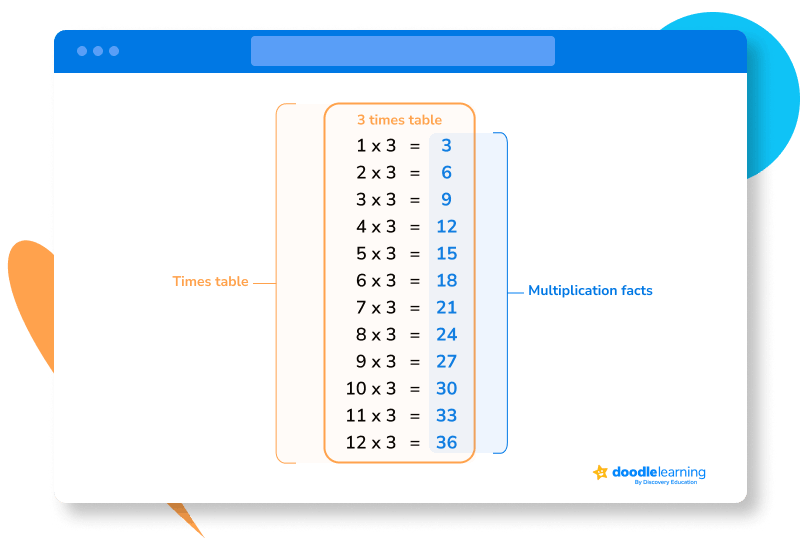
  • Times tables are the organised lists of multiples for each number
  • Multiplication facts are the individual calculations within the tables
differences between tables

Unlock unlimited maths questions

Put your learning into practice with fun exercises + games that are proven to boost ability!

Get 2 FREE weeks of Doodle!

Use code 2WKS_2026 to enjoy unlimited questions and games

Get 1 FREE month of Doodle!

Use code MONTH_2026 to enjoy unlimited questions and games

Use code 2WKS_2026 to get 2 FREE weeks of Doodle!

Use code MONTH_2026 to get 1 FREE month of Doodle!

Try DoodleMaths for free!

How to learn multiplication facts

1. Start with the easiest facts

As I’m sure we all remember from our own school days, not all multiplication facts are equally difficult. Some are much easier for learners to get their heads around, such as:

  •  x1 facts (the number stays the same)
  • x2 facts (the number doubles)
  • x5 facts (each product ends with a 0 or a 5)
  • x10 facts (adding a zero)

Starting with these facts helps build confidence and provides learners with a reference point when they need strategies for trickier multiplication facts.

2. Use visual models

Many students find that multiplication makes far more sense when they can see what the numbers actually mean. The most helpful model I use with my learners is an array which shows multiplication as rows and columns. 

For example, 3 x 4 can be represented as three rows of four objects:

● ● ● ●

● ● ● ●

● ● ● ●

This method helps children understand that multiplication means adding equal groups, and it isn’t just a set of number patterns to memorise.

3. Explore patterns in the multiplication tables

One of the most helpful things you can show learners when they’re learning their multiplication facts is the patterns that appear in the multiplication tables. Once kiddos notice these patterns, remembering the facts can become a lot easier.

For example: 

The 5 times table

  • Products alternate in ending with either 0 or 5

The 9 times table

  • The product digits often add up to 9 (e.g. 27 → 2 +7 = 9)
  • The ones digit decreases as the tens digit increases

4. Link to real-life applications

Showing children the real-life applications of the maths they’re learning is a fantastic way to make it feel relevant and meaningful to them. Multiplication appears in many everyday situations, such as:

  •  4 boxes with 6 cupcakes in each
  • 3 tables, each with 6 chairs, in a classroom
  • 5 packs of pencils with 10 pencils in each pack

Using these examples when teaching multiplication facts shows kids why multiplication is useful beyond the classroom worksheets!

5. Have strategies to help with trickier facts

To this day, I still find the 8 times table tricky! Thankfully, I have strategies to help me out. If students are still learning or finding it difficult to recall certain facts, they can often work them out from known facts. 

For example, one of the most common facts students struggle with is 7 x 6. Here’s a strategy they could use to work this out: 

  • I know that 5 x 6 = 30
  • Add on another two groups of 6 
  • 30 + 6 + 6 = 42

Encouraging learners to use strategies like this strengthens their number sense, improves their problem-solving skills, and will eventually support their recall of these multiplication facts!

6. Practice often!

In my experience, the most effective multiplication practice is short and frequent. Long practice sessions can feel overwhelming, and kids will often tire quickly, leading to mistakes and frustration. Whether it’s in the classroom or at home, some simple ideas to keep practice fast and fun are: 

  • Quick-fire multiplication questions at random points throughout the day
  • Flashcards 
  • Times table games 
  • Timed challenges
  • Partner quizzes

Just a few minutes every day can make a huge difference to learners’ confidence and recall of multiplication facts! 

Our DoodleLearning maths app and tables app are perfect for these quick-fire maths revision sessions. The apps are packed with fun, interactive games, and the programme of activities it offers to each learner adapts to their individual performance.

Try DoodleMaths for free!

Select a year group

  • Number

  • Shape, space and measure

  • Patterns

  • Number and place value

  • Addition and subtraction

  • Multiplication and division

  • Operations (ASMD)

  • Fractions

  • Measure

  • Shape/geometry

  • Statistics

  • Ratio and proportion

  • Algebra

  • Probability

Sample questions

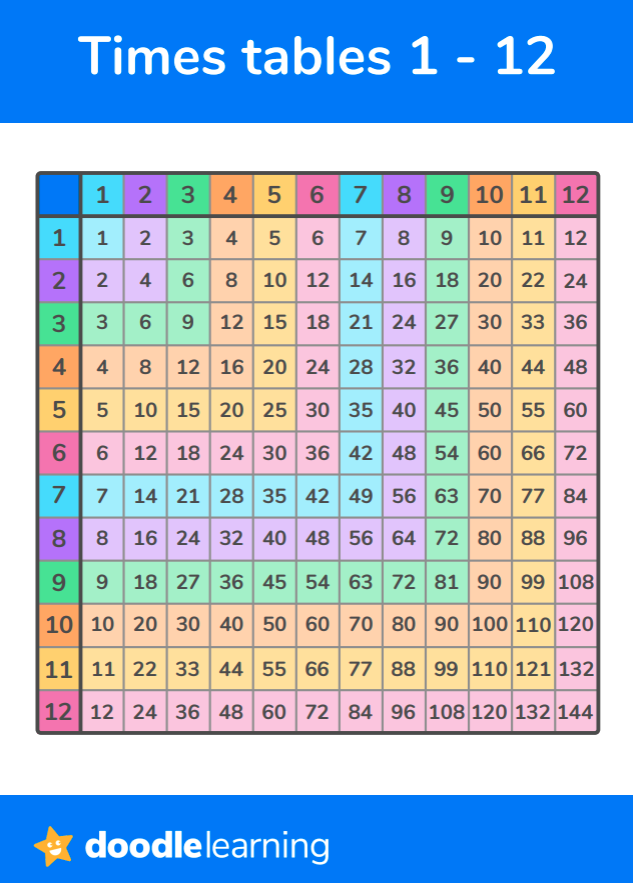
Multiplication Facts table

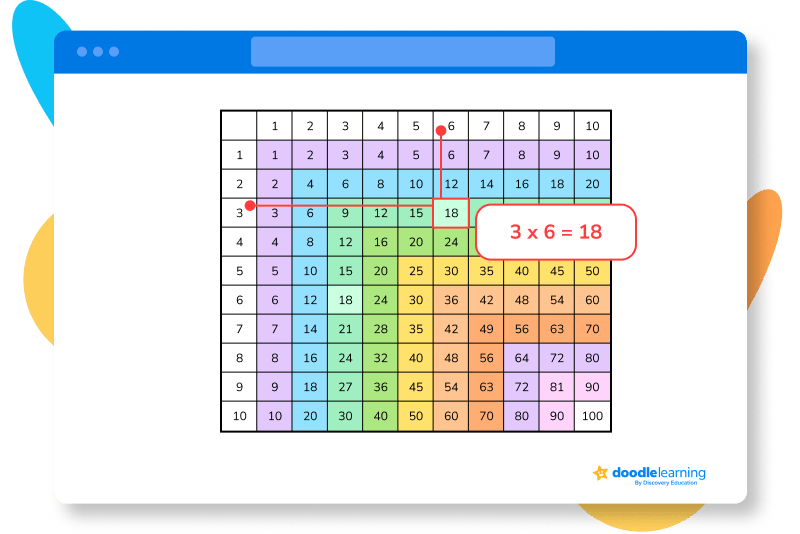
A multiplication facts table shows the products for multiplying sets of numbers from 1 to 12. These tables are also a great way for kids to see patterns in multiplication facts and times tables. 

multiplication chart 1-12

How to use:

To use a multiplication facts table, find the numbers you’d like to multiply – one on the top line and the other down the left-hand side. Then track across and find the square where the columns and rows meet. This gives you the product of your chosen multiplication!

Explore maths puzzles with DoodleMaths

Want to do more math puzzles? DoodleMaths is an award-winning maths app full of maths puzzles that are proven to double a child’s rate of progression with just 10 minutes of use a day!*

Filled with fun, interactive questions aligned to state standards, Doodle creates a unique work program tailored to each child’s needs, boosting their confidence and skills in math.

for families

*Based on earning 24 stars a day in DoodleMaths. Read full study

Use code AUTUMN_2025 to get 2 FREE weeks of Doodle!

Use code MONTH_2026 to get 1 FREE month of Doodle!

Parents, sign up for a DoodleMaths subscription and see your child become a maths wizard!

Lesson credits

Mhairi author

Mhairi Sim

Mhairi is an experienced teacher, freelance writer and parent. After completing her bachelor's degree in Psychology, she graduated as a teacher from the University of Strathclyde. She then built experience teaching across KS1 and KS2 throughout the UK. In addition to working in mainstream education, Mhairi specialised in the additional support needs sector, including social, emotional, and behavioural support.


Mhairi author

Mhairi

Mhairi is an experienced teacher, freelance writer and parent. After completing her bachelor's degree in Psychology, she graduated as a teacher from the University of Strathclyde. She then built experience teaching across KS1 and KS2 throughout the UK. In addition to working in mainstream education, Mhairi specialised in the additional support needs sector, including social, emotional, and behavioural support.

Login

Are you a parent, teacher or student?

Get started for free!

Are you a parent or teacher?

Maths information pack

We ask for your contact info so we can send our info pack directly to your inbox for your convenience

Exam prep information pack

We ask for your contact info so we can send our info pack directly to your inbox for your convenience

Case studies information pack

We ask for your contact info so we can send our info pack directly to your inbox for your convenience

Information pack

We ask for your contact info so that our Education Consultants can get in touch with you and let you know a bit more about Doodle.

Student Login

Which programme would you like to use?

If you’d like to use Doodle’s browser version, please visit this page on a desktop.

To log in to Doodle on this device, you can do so through our apps. You can find out how to download them here: