

Practice Questions

GCSE Maths: 25 Practice Questions Categorised by Topic and Difficulty

Whether you’re sitting Foundation or Higher, these 25 GCSE maths practice questions will help you revise every major topic — with worked answers included.

Author

Mhairi Sim

Published:

July 2026

Key takeaways

  • GCSE maths questions are across six topics: Number, Algebra, Ratio and Proportion, Geometry and Measures, Probability, and Statistics

  • The GCSE maths exam is split into two tiers: Foundation (grades 1-5) and Higher (grades 4-9)

  • Always show your working – examiners marking GCSE maths questions award marks for method, not just the final answer.

What is GCSE Maths?

The GCSE maths qualification is widely considered a gateway qualification, meaning it is a requirement for entry to many sixth form colleges and further education establishments, as well as for many future careers.

GCSE maths is a compulsory subject for students in England, Wales, and Northern Ireland (students in Scotland sit an equivalent qualification), and most students will typically begin their studies at age 15 or 16.

The exam will present students with GCSE maths questions across six main topic areas: Number, Algebra, Ratio and Proportion, Geometry and Measures, Probability, and Statistics. The exam exists at two different difficulty levels, referred to as tiers, where students can achieve different GCSE grades:

  • Foundation tier = Awarded grade 1 -5
  • Higher tier = Awarded grade 4 – 9


Visit our guide on GCSE Grade Boundaries to learn more about the GCSE grading system.

Whatever tier you’re sitting, completing GCSE practice questions is one of the most effective revision tools! Working through problems, checking your answers, and understanding where you went wrong is proven to boost performance far more than simply reading a textbook or looking over your notes.

With that in mind, we’ve put together 25 curriculum-aligned practice GCSE maths questions split by topic and tier. Each question has a fully worked answer, so you can check your work at every step. Before you get started, here are some tips to help you get the best out of these practice questions.

How to Make the Most of These GCSE Maths Questions

Working through these GCSE maths questions is only useful if you’re learning from them. Here are a few tips to get the most out of your revision: 

  1. Give each practice question your best try before looking at the answer. This might sound obvious, but if you’re peeking at the answers before you attempt, then you aren’t getting a true reflection of how you’d actually handle the questions in a real exam scenario! Struggling with a question and thinking your way through it helps the correct method stick far better than just looking at the solutions!
  2. Show your working. You’ve heard it a thousand times from your teachers, and now here too! And for good reason! GCSE maths examiners award marks for method, not just the final answer. Get into the way of writing out every step now – it’ll stop you losing marks in the exam and help with your timing. 
  3. Don’t just focus on ‘right’ or ‘wrong’ marks. When you check your answers, look at exactly where your work looks different from the model answers. Did you calculate incorrectly? Or did you misunderstand the method? This will help you direct any follow-up revision!
  4. Come back to the questions you got wrong in a few days. Try them again (without looking at the answer!) and see if you can do it correctly the second time around. If not, then you’ll need to schedule some time to revise the topic again. 
  5. Use the Foundation and Higher split wisely. If you’re sitting the foundation paper, focus your energy on these questions first and make sure you’re confident before challenging yourself. If you’re sitting higher, remember you will still be tested on the foundation content, so don’t skip these!

Practice GCSE Maths Questions

Grab some paper, a pen, and your calculator. You’ve got everything you need to get started now.

As a rough guide, GCSE exam questions follow a 1 mark per minute rule of thumb, so the following questions should take around 1 hour to complete.

You may only use a calculator for the questions indicated. A calculator symbol will appear next to the question number if it is allowed.

Number

Foundation

Q1.

A family buys 4 tickets at 3.30 pm. They also buy one portion of popcorn.
How much do the family spend on their cinema trip?

(3 marks)

Show Answer


4 x £6.50 = £26.00
10% of £26.00 = £2.60 (1 mark)

£26.00 – £2.60 = £23.40 (1 mark)
£23.40 + £5.25 = £28.65 (1 mark)

Q2.

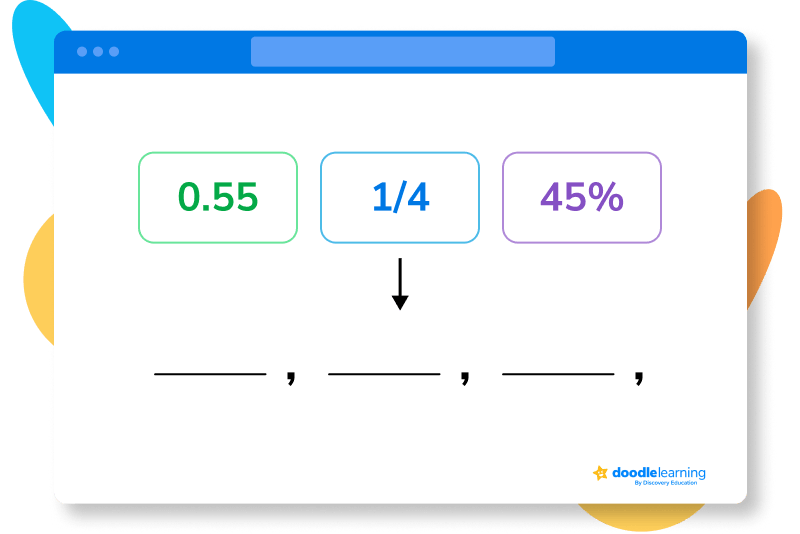
Write the numbers in order of size from smallest to largest.
Show Answer


¼, 45%, 0.55 (1 mark)

Q3.

Write the fraction in its simplest form.

(1 mark)

Show Answer


⅖ (1 mark)

Higher

Q4.

Solve 7x – 27 < 8

(2 marks)

Show Answer


7x < 8 +27
7x < 35 (1 mark)
(divide by 7)
x < 5 (1 mark)

Q5.

A shop reduces all prices by 15%. Sophie buys a jumper which originally cost £40 and one other item. After the discount, her total comes to £57.80. What was the original cost of the other item she bought?

(3 marks)

Show Answer


£57.80 ÷ 0.85 (1 mark)
= £68.00 (1 mark)
£68.00 – £40.00 = £28.00 (1 mark)

Q6.

Isla paid £20 for 48 keyrings.
She sells all 48 keyrings for £1 each.
Work out her percentage profit.

(3 marks)

Show Answer


48 x £1 = £48
£48 – £20 = £28 (1 mark)
() x 100 (1 mark)
= 140% (1 mark)

Algebra

Foundation

Q7.

Solve:
4 (x – 5) = 18

(2 marks)

Show Answer


4x – 20 = 18 (1 mark)
4x = 18 + 20
4x = 38
x = 9.5 (1 mark)

Q8.

Expand and simplify:
(x + 5)(x + 2)

(2 marks)

Show Answer


x + 2x + 5x + 10 (at least ¾ terms here correct: 1 mark)
x + 7x + 10 (1 mark)

Higher

Q9.

Simplify fully:

(2 marks)

Show Answer


= (top line correct: 1 mark)

= x + 4 (1 mark)

Q10.

Here is a sketch of a curve. The equation of the curve is y = x² + ax + b, where a and b are integers.
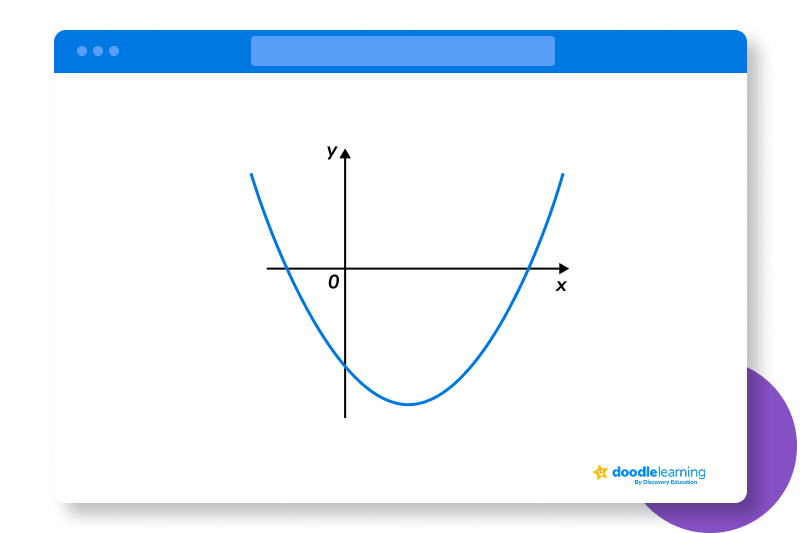
The points (0, – 5) and (5, 0) lie on the curve.
Find the coordinates of the turning point of the curve.

(5 marks)

Show Answer

Step 1: Sub in (0, -5)
– 5 = 0 + 0 + b
b = – 5 (1 mark)

Step 2: Sub in (5, 0) and b = – 5 from step 1
0 = 5² + 5a – 5 (1 mark)

0 = 25 + 5a – 5
0 = 20 + 5a

5a = – 20
a = – 4 (1 mark)

Step 3: Complete the square
y = x² – 4x – 5 (1 mark)

Q11.

Use algebra to solve the simultaneous equations

4x – 5y = 20

6x + 7y = – 57

You must show all your working.

(4 marks)

Show Answer


Step 1: Make the x coefficients match (1 mark if both are correct below)
(4x – 5y = 20) x 6 → 24x – 30y = 120

(6x + 7y = – 57) x 4 → 24x + 28y = – 228

Step 2: Subtract one equation from the other
(24x + 28y) – (24x – 30y) = – 228 – 120 (1 mark)
28y + 30y = – 348
=
y = – 6 (1 mark)

Step 3: Substitute the y value into equation 1
4x – 5y = 20
4x – 5(-6) = 20

4x + 30 = 20

4x = 20 – 30

=
x = – 2.5 (1 mark)


(To check your work, you can substitute both values back into the second equation to get an equal result.)

Ratio, Proportion, and Rates of Change

Foundation

Q12.

A paint mixture uses red, blue and green paint in the ratio 2 : 3 : 4. If a decorator uses 12 litres of green paint, what is the total amount of paint in the mixture?

(2 marks)

Show Answer


=
1 part = 3 litres (1 mark)
2 + 3 + 4 = 9
9 x 3 litres = 27 litres (1 mark)

Q13.

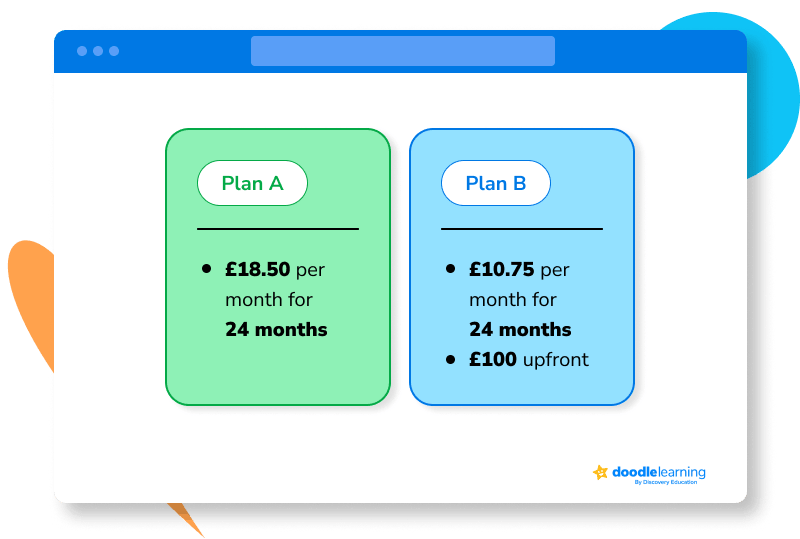
Two mobile phone contracts are available.

Which plan is the better deal? Show your working.

(3 marks)

Show Answer


Plan A : £18.50 x 24 = £444.00 (1 mark)
Plan B: £10.75 x 24 = £258.00 + £100 = £358.00 (1 mark)
Plan B is the better deal as it is £86 cheaper. (1 mark)

Higher

Q14.

Given that
a:b = 2:5 and b:c = 3:4
Find a:b:c.

(2 marks)

Show Answer


Find the least common multiple of 5 & 3 (15) (1 mark if 15 is identified and at least 1 of a:b or b:c is scaled correctly as below)
a:b = 2:5 (x3) → 6:15
b:c = 3:4 (x5) → 15:20
a:b:c = 6:15:20 (1 mark)

Q15.

x is proportional to where y > 0

y is increased by 44%

Work out the percentage increase in x.

(3 marks)

Show Answer


x = k

Step 1: Work out the y value
y = 44% increase = 100% + 44% = 144% = 1.44
(1 mark if: x = k and y = 1.44y has been written)

Step 2: Substitute in the y value to calculate the x value (1 mark for below 2 lines)
x = k
x = k1.2

Step 3: Compare the new x value to the previous
k1.2 – k
0.2 = 20% increase (1 mark)

Geometry and Measures

Foundation

Q16.

A car travelled for 7.04 miles at an average speed of 30.2 miles per hour.
Work out an estimate for the time taken for the car to complete the journey. Give your answer in minutes.

(2 marks)

Show Answer


Round answers for estimates
7 miles ÷ 30 miles per hour (1 mark)
= 0.233 hours
0.2333 hours x 60 minutes = 14 minutes (1 mark – accept answers between 13-15 minutes)

Higher

Q18.


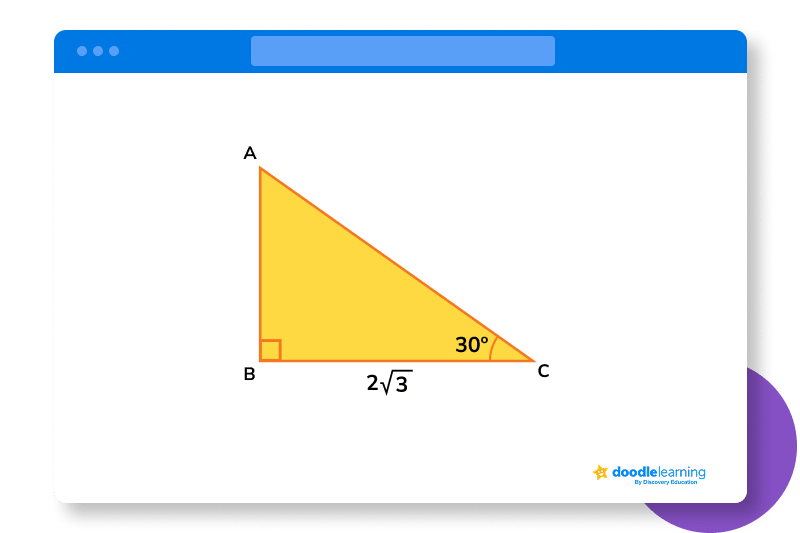
Work out the length of AB.

(2 marks)

Show Answer


tan(30°) = AB ÷ BC (1 mark)
AB = 2√3 x tan(30°)
AB = 2√3 x 1√3
AB = 2√3 ÷ √3
AB = 2 cm (1 mark)


Q19.

Determine whether this triangle is right-angled. Show your working.
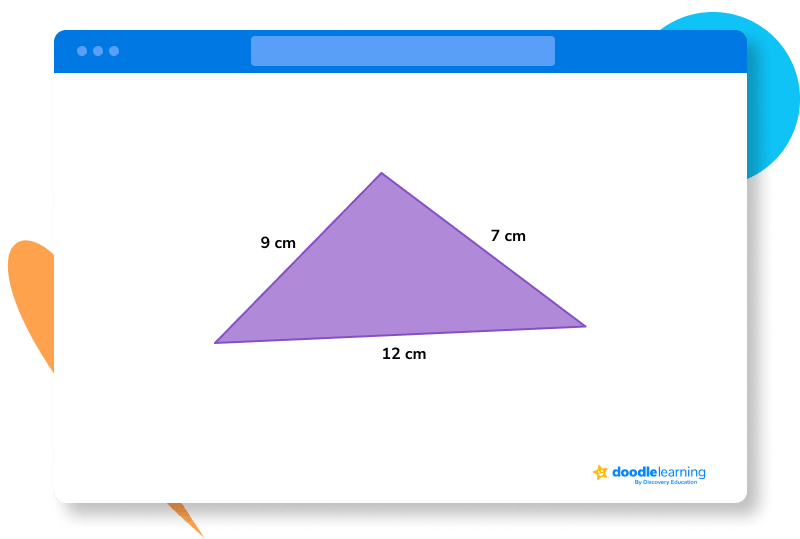
(3 marks)

Show Answer


7² + 9² = 49 + 81 = 130 (1 mark)
12² = 144 (1 mark)
130 ≠ 144, therefore the triangle is not right-angled (1 mark – written statement conclusion required)

Try DoodleMaths for free!

Select a year group

  • Number

  • Shape, space and measure

  • Patterns

  • Number and place value

  • Addition and subtraction

  • Multiplication and division

  • Operations (ASMD)

  • Fractions

  • Measure

  • Shape/geometry

  • Statistics

  • Ratio and proportion

  • Algebra

  • Probability

Sample questions

Probability

Foundation

Q20.

A bag contains 3 red and 2 blue counters. One counter is picked at random. What is the probability that it is red?

(1 mark)

Show Answer


P(red) = ⅗ (1 mark)

Q21.

A fair spinner numbered 1-5 is spun twice, and the numbers landed on are recorded. Find the probability that:

Q21a.

The total of the two numbers is even

(2 marks)

Show Answer


P(both odd) = 3/5 x 3/5 = 9/25
P(both even) = 2/5 x 2/5 = 4/25
(1 mark – both of the above written)
P(even total) = 9/25 + 4/25
= 13/25 (1 mark)

Q21b.

The spinner does not land on the same number twice

(2 marks)

Show Answer


There are 5 ways the same number can happen (1,1 or 2,2 or 3,3 or 4,4 or 5,5) out of a possible 25 outcomes in total.
P(same number both times) = 5/25 = 1/5 (1 mark)
P(not the same number) = 1 – 1/5

= 4/5 (1 mark)

Higher

Q22.

Callum goes to the cinema and will watch either a sci-fi, horror or a romantic comedy movie. The probability he chooses a romantic comedy is 0.56. There is an equal chance that he picks a sci-fi or horror.
Find:

Q22A.

The probability that he picks a horror movie.

(2 marks)

Show Answer


1 – 0.56 = 0.44 (1 mark)
0.44 ÷ 2 = 0.22 (1 mark)

Q22B.

The probability that he picks a horror or romantic comedy.

(1 mark)

Show Answer


0.22 + 0.56 = 0.78 (1 mark)

Statistics

Foundation

Q23.

The mean of 6, 8, 19, 8, and x is 8.4. Find x.

(2 marks)

Show Answer


8.4 x 5 = 42
6 + 8 + 19 + 8 = 41 (1 mark)
42 – 41 = 1
x = 1 (1 mark)

Q24.

The pie charts show information about the meals that children at two different schools ate for lunch.

The same number of students at each school had pizza for lunch. Is this statement correct? Show your working that helps you reach your answer.

(3 marks)

Show Answer


School A: x 480 = 80 students (1 mark)

School B: x 760 = 190 students (1 mark)
80 ≠ 190, so the statement is incorrect. (1 mark)

Higher

Q25.

A teacher records the number of hours students spent revising for a GCSE maths test and their percentage score in the test. The table below shows the results for 8 students:

Hours revisedTest score (%)
241
348
452
561
666
771
878
1062

Q25a.

Describe the relationship between revision time and test score.

(1 mark)

Show Answer


There is a positive correlation between revision time and test score (1 mark)

Q25b.

Which result may be considered an outlier? Explain your answer.

(1 mark)

Show Answer


The student who studied for 10 hours but scored 62% is the outlier, as the pattern suggests they should have scored much higher. (1 mark)

Q25c.

You want to estimate the test score of a student who revised for 9 hours. Describe the method and steps you would use to do this.

(2 marks)

Show Answer


1. Plot the data on a scatter graph
2. Ignore the outlier (10 hours, 62%)
3. Draw a line of best fit through the remaining points
4. Find 9 hours on the horizontal axis and draw a line up to the line of best fit
5. Read across to the vertical axis to find the estimated score. (2 marks)

Congratulations! You’ve reached the end of our practice GCSE maths questions! Were you able to stick to the 1-minute-per-mark timing? Now it’s time to go back and mark your work using our answers.

Remember, don’t let incorrect answers get you down. These are all part of the learning! If you did get any wrong, use our worked answers to figure out what went wrong and try the question again in a couple of days.

Looking for more GCSE support? DoodleLearning has a range of articles to help you navigate exam season, from understanding your results and grade boundaries to what to expect on GCSE results day.

Congratulations! You’ve reached the end of our practice GCSE maths questions! Were you able to stick to the 1-minute-per-mark timing? Now it’s time to go back and mark your work using our answers.

Looking for more GCSE support? DoodleLearning has a range of articles to help you navigate exam season, from understanding your results and grade boundaries to what to expect on GCSE results day.

Practise for SATs with DoodleLearning!

Looking for more SATs practice? DoodleLearning is an award-winning maths and English app that’s filled with thousands of questions and games aligned to the national curriculum!

Designed by teachers, it creates each child a unique work programme tailored to their needs, doubling their progression with just 10 minutes of use a day.* Try it for free!

for families

*Based on children earning 24 stars a day. Read the full study here.

Lesson credits

Mhairi author

Mhairi Sim

Mhairi is an experienced teacher, freelance writer and parent. After completing her bachelor's degree in Psychology, she graduated as a teacher from the University of Strathclyde. She then built experience teaching across KS1 and KS2 throughout the UK. In addition to working in mainstream education, Mhairi specialised in the additional support needs sector, including social, emotional, and behavioural support.


Mhairi author

Mhairi

Mhairi is an experienced teacher, freelance writer and parent. After completing her bachelor's degree in Psychology, she graduated as a teacher from the University of Strathclyde. She then built experience teaching across KS1 and KS2 throughout the UK. In addition to working in mainstream education, Mhairi specialised in the additional support needs sector, including social, emotional, and behavioural support.

Login

Are you a parent, teacher or student?

Get started for free!

Are you a parent or teacher?

Maths information pack

We ask for your contact info so we can send our info pack directly to your inbox for your convenience

Exam prep information pack

We ask for your contact info so we can send our info pack directly to your inbox for your convenience

Case studies information pack

We ask for your contact info so we can send our info pack directly to your inbox for your convenience

Information pack

We ask for your contact info so that our Education Consultants can get in touch with you and let you know a bit more about Doodle.

Student Login

Which programme would you like to use?

If you’d like to use Doodle’s browser version, please visit this page on a desktop.

To log in to Doodle on this device, you can do so through our apps. You can find out how to download them here: