





Key takeaways
Number bonds aren’t the most talked-about maths concept, but they are one of those key, foundational pieces of the puzzle that have a big impact on a child’s future maths confidence and success.
Our complete guide to number bonds will cover the basics of what a number bond is, how they work and exactly why they’re important for learners. We’ll also even share some tried-and-tested activities to make this essential learning a bit more fun for your little ones!
Pairs of numbers that add together to make a specific total are commonly known as number bonds. For example, number bonds to 10 include pairs like: 7 + 3, 4 + 6, and 8 + 2. This may seem like a pretty simple concept, but it’s a key learning point in early maths that kids will draw upon time and time again.
Eventually we just “know” our times tables and this ability to recall the answers helps us with a range of mental maths problems. In early maths learning, before times tables, little ones need to start with number bond pairs to build number sense and give them the building blocks for addition and subtraction.
Number bonds work off the part-whole model. This is the concept that a whole number can be split into parts, specifically two parts when working on number bonds.
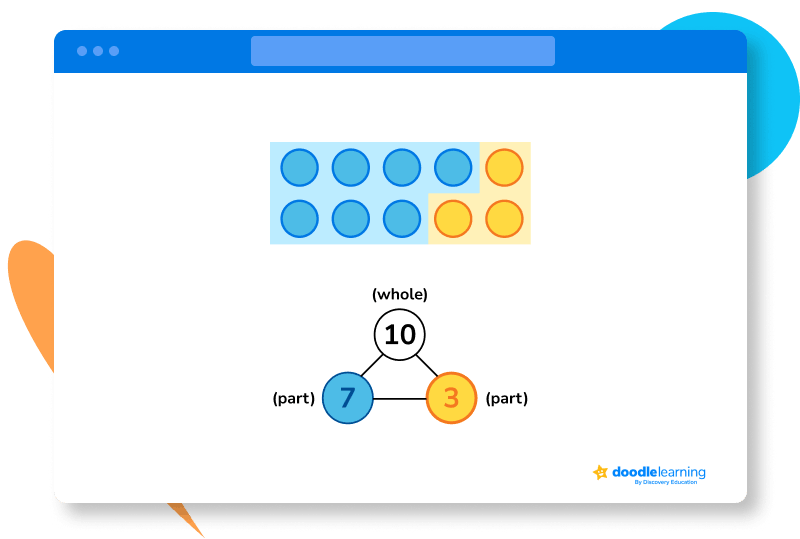
In the classroom, I loved using resources like Numicon to demonstrate this concept in examples like this one below, where kids can easily see that the whole (10) is made up of two parts (7 and 3).
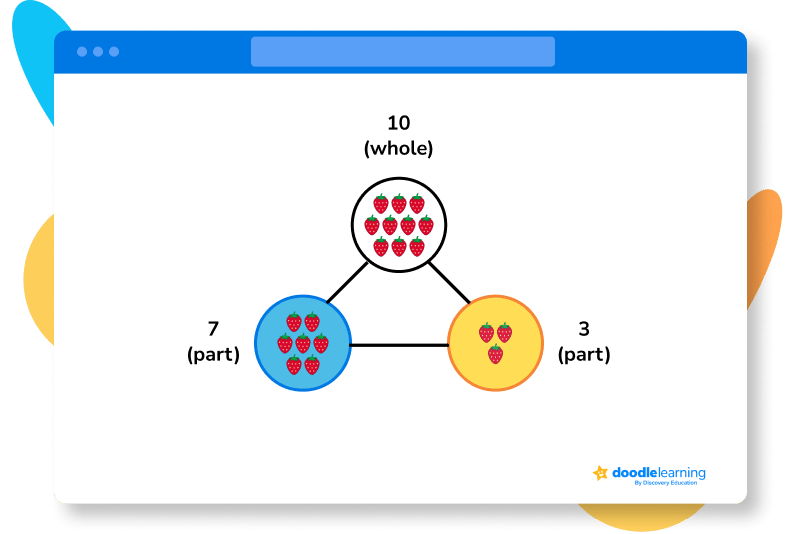
Another method that can be quite effective is to use pictorial examples. The example below demonstrates the same number bond as above:
The simple answer is yes, number bonds are important! Not only are number bonds helpful with addition and subtraction learning, the concept of parts added together making a whole is key for later learning. Learners who don’t fully get their heads around number bonds and the concept of parts making a whole can really struggle later on.
This struggle can appear in topics that might seem unrelated and might take years to actualise. However, processes like column addition and subtraction, and division and multiplication are all built on the understanding of parts and wholes.
Children start learning number bonds as early as the reception year. My own son has just finished his reception year, and after number recognition and cardinality, this was the next thing they covered!
The number bonds KS1 learners usually cover are bonds to 10 and 20. The number bonds Year 1 and Year 2 cover prepares them for work in early Key Stage 2, as they learn to calculate within 100.
As per the English National Curriculum for maths, the progression year on year for number bonds and related learning is as follows:
*Some schools may begin teaching number bonds to 20 in Year 1.
Unlock unlimited maths questions
Put your learning into practice with fun exercises + games that are proven to boost ability!
Get 2 FREE weeks of Doodle!
Use code 2WKS_2026 to enjoy unlimited questions and games
Get 1 FREE month of Doodle!
Use code MONTH_2026 to enjoy unlimited questions and games
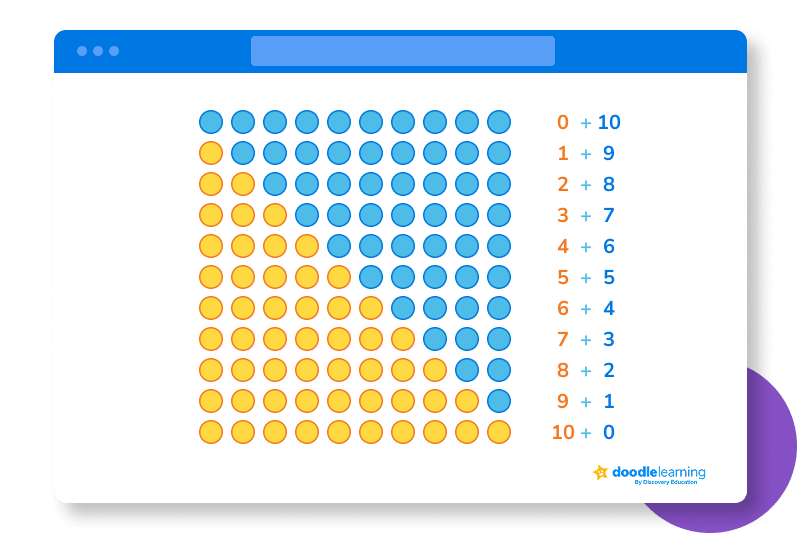
The first milestone in number bond learning is 10. This is the most important stage, as it’s what everything else is built on – even when students start learning about place value, everything makes sense when considered in tens.
Eleven different number bonds exist to make the number ten, and these are the first to learn!
When it comes to number bonds to 20, kids will rely on their secure knowledge of bonds to 10 to use the “make 10 first” strategy. This is a common strategy we teach when doing addition calculations that bridge 10.
For example, when solving 8 + 6, we might try to first make 10. We know that 8 + 2 = 10, meaning we now only need to add 4; 10 + 4 = 14
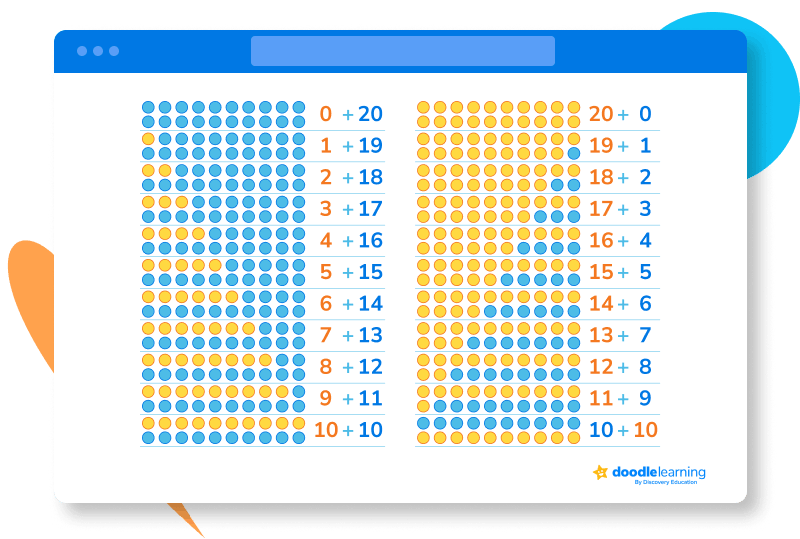
21 number bonds exist to make the number 20, or 11 unique pairs of numbers. Learners should notice that the pattern and paired numbers follow number bonds to 10 closely, just with one number being ten more, e.g. instead of 2 + 8, with bonds to 20 we are now working with 2 + 18.
Learning number bonds to 100 first begins with working in tens. In Year 2, learners will know how to count in tens (10, 20, 30, and so on). Combining this with their existing number bonds knowledge, learners can then determine bonds such as 30 +70 = 100.
In Year 3, learners develop this further by exploring more complicated bonds to 100 such as 25 + 75 = 100.
Try DoodleMaths for free!
Select a year group
Teaching number bonds effectively ultimately comes down to the learners in front of you and what works best for them! In my experience, whether it’s the students in my class or my own little ones at home, the key is little and often.
The concrete, pictorial, abstract approach (often referred to as the CPA approach) is a method we use to teach a lot of different concepts in schools with our little ones. It’s brilliant as it lets learners explore concepts using three different methods:
Remember that with the CPA approach, there’s no rule that says learners must start at concrete and work towards pictorial and abstract. I’ve had many students who were just not interested in working with the physical resources offered by the concrete approach, but who found that the pictorial representations just clicked.
You’re always onto a winner when you make learning fun for your little ones. Here are some of the most effective number bonds activities I’ve done with my kids, both in the classroom and with my own children at home:
Let your little ones make bracelets showing number bonds. For example, they could do seven blue beads and three yellow beads to show a number bond to 10.
Learners must mark off numbers on their bingo board when you call out the corresponding number in the number bond.
DoodleLearning’s maths app has lots of number bonds games which are perfect for the kind of little-and-often revision that makes learning stick. It’s one I use regularly with my own five-year-old and the adaptive programme has already made a real difference to his maths confidence!
Number bonds might look like a tiny part of the maths curriculum, but they’re so important for the learning that follows. Yes, they can be a bit repetitive, but a little practice often will go a long way in boosting your learners’ maths confidence and abilities!
Want to do more math puzzles? DoodleMaths is an award-winning maths app full of maths puzzles that are proven to double a child’s rate of progression with just 10 minutes of use a day!*
Filled with fun, interactive questions aligned to state standards, Doodle creates a unique work program tailored to each child’s needs, boosting their confidence and skills in math.
*Based on earning 24 stars a day in DoodleMaths. Read full study
Lesson credits

Mhairi Sim
Mhairi is an experienced teacher, freelance writer and parent. After completing her bachelor's degree in Psychology, she graduated as a teacher from the University of Strathclyde. She then built experience teaching across KS1 and KS2 throughout the UK. In addition to working in mainstream education, Mhairi specialised in the additional support needs sector, including social, emotional, and behavioural support.


Mhairi
Mhairi is an experienced teacher, freelance writer and parent. After completing her bachelor's degree in Psychology, she graduated as a teacher from the University of Strathclyde. She then built experience teaching across KS1 and KS2 throughout the UK. In addition to working in mainstream education, Mhairi specialised in the additional support needs sector, including social, emotional, and behavioural support.

Book a chat with our team
If you’d like to use Doodle’s browser version, please visit this page on a desktop.
To log in to Doodle on this device, you can do so through our apps. You can find out how to download them here: