






Key takeaways
The unassuming ten frame doesn’t look like much, just a simple grid of ten boxes- so what are they and why are they so important? Ten frames are visual tools that support learning in EYFS and KS1 across concepts like counting, cardinality, addition, subtraction, and other aspects that contribute to building a strong understanding of number.
In this guide, we’ll explore how ten frames work and just why they’re so important for early maths learning. We’ll also share some ways to get creative in making your own and share some fun ten frames activities you can play with your little learners!
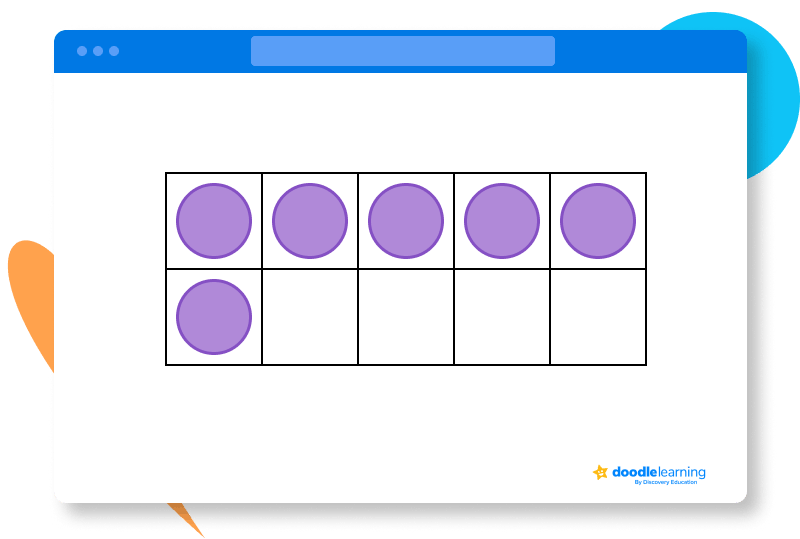
A ten frame (or tens frame) is a rectangular grid with ten boxes, made up of two rows of five boxes. In the classroom, we use them to support our learners when they’re counting, adding, and subtracting. We’ll use cubes, counters, toys, or even draw dots to fill the ten frames, whatever is to hand!
Ten frames are an excellent way to help kids visualise what’s going on when we’re completing basic maths operations. As well as being a helpful aide for this, they help learners build their number sense and understand parts and wholes, particularly when it comes to place value.
The main reason that a tens frame works so well is because it always looks the same. This predictable format means that kids eventually aren’t having to count from scratch each time, which builds their ability to subsitise, or recognise quantities at a glance.
For example, in the example below, learners will eventually recognise, without individually counting the dots, that a full row is five, and that one below means this quantity is six.
Unlock unlimited maths questions
Put your learning into practice with fun exercises + games that are proven to boost ability!
Get 2 FREE weeks of Doodle!
Use code 2WKS_2026 to enjoy unlimited questions and games
Get 1 FREE month of Doodle!
Use code MONTH_2026 to enjoy unlimited questions and games
Ten frames are important as they’re an excellent tool that gives learners something unchanging and predictable to work with when learning new skills or information. Remember, for reception children, numbers and counting are still fairly abstract concepts, and they don’t have that internal number line or secure understanding of number order yet.
Even when they can count to 10, the concept of what ‘ten’ actually looks like as an amount can still feel quite abstract. I remember my own son at age four telling me that he thought there were ten pieces of rice on his plate, simply because that was the biggest number he knew!
So the seemingly simple ten frame is actually incredibly important to build kids’ number sense. Which, when it comes to tackling more complicated maths challenges later on, is a key skill.
You’ll usually see ten frames begin appearing in reception year, and they’ll be around until children are confidently working with numbers and have developed a strong number sense. I’ve been known to break out a tens frame even in a Year 5 classroom if I feel a student needs to go back to basics to really understand something we are covering.
Generally speaking, a ten frame will be a staple in EYFS and Key Stage 1 classrooms, but how we use them at each stage will differ slightly.
| Year Group | How Ten Frames Are Used |
|---|---|
| Reception Year (EYFS) | The ten frame EYFS students will use are introduced through play-based learning. Learners will fill them with small concrete materials like toys, buttons or beads to practice their counting skills. This helps to build learners’ number recognition abilities and their understanding of cardinality, i.e. 7 = seven objects on the ten frame. |
| Year 1 (KS1) | In Year 1, ten frames are used more regularly as a tool to support formal classroom learning. Using a ten frame Year 1 will develop their understanding and awareness of number bonds to 10 and beyond. |
| Year 2 (KS1) | By this stage, students won’t be so reliant on ten frames. They’ll be confidently recalling number bonds and be using mental strategies for addition and subtraction. However, using them for addition or subtraction where we are bridging tens is common as we develop kiddos’ understanding of place value. |
While a lot of schools have loads of ten frame resources, if yours doesn’t, or if you’re working on this from home, you don’t need to spend any money on these! Ten frames are easy to make – after all, they’re just two rows of five boxes -and it can be as simple as just drawing one out on a piece of paper!
If you’re looking to get a bit more creative, here are some DIY how to make a ten frame ideas I’ve used in the past that I’d definitely recommend:
Take a 12-cup egg box, cut two cups off the end and voilà – a (very basic) ten frame! To make it a little more exciting, let your kids personalise it with pens, paint, glitter – whatever makes it more them!
Create a tens frame on the carpet with masking tape or use chalk to draw one on the ground outside. You can then use your students to fill this life-size frame for an extra interactive element.
Print ten frames onto paper, then let your kids personalise the page to make it a bit more appealing. Laminate to ensure they last the whole school year!
Build frames with lollypop or popsicle sticks and stick them with glue or Blu Tack if you want them to last. If not, just have kids lay out the sticks on the table for the session, then tidy them up again at the end.
Try DoodleMaths for free!
Select a year group
Ten frames more than earn their keep when it comes to games and hands-on activities! Ten frame maths games are a perfect way to make using this tool fun. Here are ten of my go-to ten frame games to support learning number bonds, addition and subtraction.
Hold up a partly filled ten frame for a few seconds before hiding it again. Get learners to call out or write the number shown and the missing amount (the bond pair) that takes the total up to 10.
Hide some ten frame maths cards around the room, each with a different number of boxes filled. Call out a number and let kids take turns at trying to find the correct matching card for the bond.
Let kids work in pairs for this one. Player 1 fills a frame as much as they want, keeping it hidden and tells their partner the bond partner of the number they’ve made. Player 2 then needs to guess the number on the tens frame using the information their partner gave them.
This is just like normal snap, but instead of pairing up matching number cards, players must pair up cards which show matching bonds (e.g. a frame with 3 matches with a frame showing 7).
Give each learner a bingo card showing a few differently partially filled ten frames. Call out a number, and if they’ve got the frame that shows that number, they can mark it off.
Show two tens frames side by side and let learners combine the quantities and count the total. This ten frame addition activity is great if your learners are gearing up for calculations that will bridge ten!
Start with a full ten frame, then have players close their eyes while one player removes some counters. The other players work out how many counters have been taken away. Have them write the number sentence for an extra challenge in this ten frame subtraction activity!
Here’s another one to play in pairs! Each player has one tens frame, and they will take turns rolling a die, adding counters after each roll. If they roll a three, then they place three counters in their ten frame. The first to 20 wins!
(To make it harder, add the rule that players need to get an exact number to win. For example. if there are only three spaces left and they roll four, they try again).
Give your students a word problem and have them show it back to you on a tens frame. For example, you could say “There were 8 birds in the tree, and then 3 flew away.” Your learners would then put 8 counters in the frame first, then remove 3.
Ten frames feature heavily on DoodleLearning’s maths app for learners working at the EYFS/KS1 level. The adaptive programme of activities focuses on counting and using ten frames to become familiar with different quantities at a glance, something which has really boosted my own 5-year-old’s maths skill and confidence!
Tens frames are simple tools, but hopefully it’s clear just how important they are for learning! Their simplicity is exactly what makes them so effective for our EYFS and KS1 learners while they develop their number sense.
Want to do more math puzzles? DoodleMaths is an award-winning maths app full of maths puzzles that are proven to double a child’s rate of progression with just 10 minutes of use a day!*
Filled with fun, interactive questions aligned to state standards, Doodle creates a unique work program tailored to each child’s needs, boosting their confidence and skills in math.
*Based on earning 24 stars a day in DoodleMaths. Read full study
Parents, sign up for a DoodleMaths subscription and see your child become a maths wizard!
Lesson credits

Mhairi Sim
Mhairi is an experienced teacher, freelance writer and parent. After completing her bachelor's degree in Psychology, she graduated as a teacher from the University of Strathclyde. She then built experience teaching across KS1 and KS2 throughout the UK. In addition to working in mainstream education, Mhairi specialised in the additional support needs sector, including social, emotional, and behavioural support.


Mhairi
Mhairi is an experienced teacher, freelance writer and parent. After completing her bachelor's degree in Psychology, she graduated as a teacher from the University of Strathclyde. She then built experience teaching across KS1 and KS2 throughout the UK. In addition to working in mainstream education, Mhairi specialised in the additional support needs sector, including social, emotional, and behavioural support.

Book a chat with our team
If you’d like to use Doodle’s browser version, please visit this page on a desktop.
To log in to Doodle on this device, you can do so through our apps. You can find out how to download them here: